
The Angus Difference
A lot of firsts happened in the 1870s. The decade opened with John D. Rockefeller founding one of the world’s first multinational companies, Standard Oil Company, and soon after, the state of Mississippi elected the first African American to congress. Two years later, President Ulysses S. Grant declared Yellowstone the first National Park, and by the end of 1875, the first zoo on American soil would open in Philadelphia. And during this time, in the small British settlement of Victoria, Kansas, Scottish-born George Grant was procuring greatness with the development of what many consider the best beef in the world—American-born and -bred Black Angus.
With a dream to build an English ranching colony, Grant had four Aberdeen Angus cattle imported from his homeland. Sadly, the settlement would be devastated by drought, prairie fires and grasshoppers and many settlers, unequipped for the harsh environment, perished. Impervious to what some saw as failure, Grant stayed on and with help from others who shared his dream eventually was able to breed the hardy, Scottish-born bulls with native longhorns—producing extraordinarily black, hornless calves. The crossbreed thrived and though initially thought of as freaks, because they had no horns, they proved better able to survive winters, on average weighing 150 pounds more come spring. Thus, the demand for this type of cattle grew and between 1878 and 1883, roughly 1,200 cattle were imported, most of them to the Midwest. Nowadays, there are registered Angus ranches in all 50 states, and right here in Indiana the Linz family is raising the purest Angus of them all—Angus that’s served in some of the country’s best steakhouses.
The Gold Standard
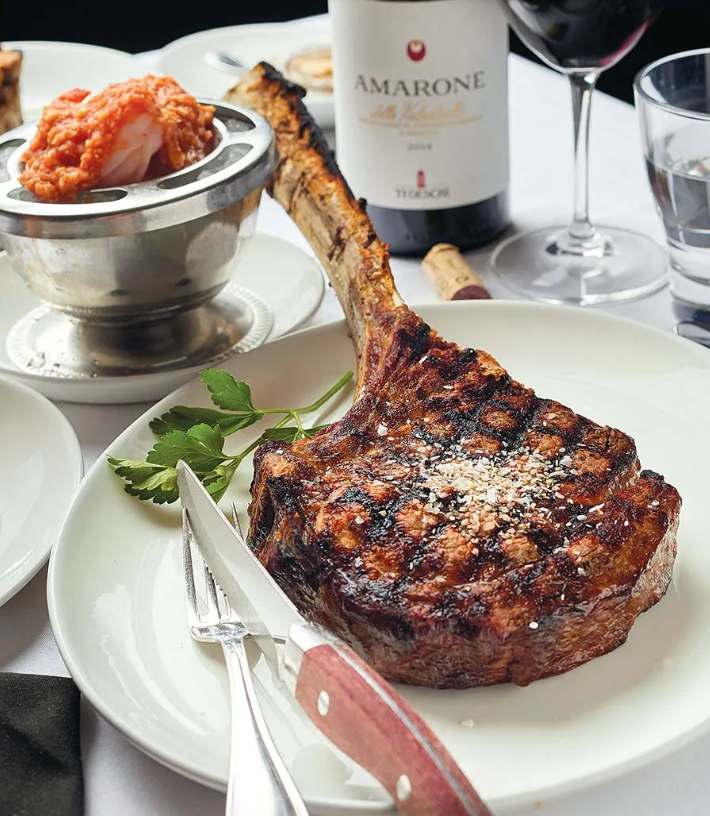
St. Elmo is the longest-standing steakhouse in Indianapolis, serving out of its original location since 1902. And though it’s known for serving a wicked-hot shrimp cocktail and unmatched, professional service, it’s the steak that locals and out-of-town guest rave about. “We serve everything from a 60-day-dry-aged USDA prime tomahawk ribeye, to a 30-day-wet-aged USDA prime NY strip, to a properly trimmed, 30-day-aged center-cut USDA choice filet, to a grass-fed flat-iron steak,” says Craig Huse, co-owner of Huse Culinary adding that ultimately it’s their guests’ preferences for flavor, tenderness, feed style and even price that drives their menus.
“It’s our responsibility,” says Huse, “to identify our patrons’ priorities then exceed their expectations.”
Grade, Age, Flavor
Angus is a particular breed of beef cattle, while prime, choice and select are the three most commonly seen of the USDA’s eight beef grades. Though there are other criteria, the main determinant for grading beef is the amount of marbling, prime having the highest levels. Only 2 percent of all beef in the U.S. is labeled prime, with around 45 percent graded choice and 21 percent, select. Typically, Angus has a higher concentration of intramuscular fat, making a USDA prime-grade Angus steak one of the most flavorful cuts of beef in the world—and when it’s dryaged, the flavor becomes even more intense.
Different than wet-aging, which means meat has been allowed to age inside a vacuum-sealed container, dry-aged beef is hung in a temperature-controlled room regulated for airflow and humidity levels. Wet-aging beef takes less time and costs the manufacturer less to produce, typically resulting in a lower market price than dry-aged beef. But the real difference is in the taste and texture, which many steak enthusiasts agree is tender, rich and buttery with a slight earthy flavor.
“Dry-aging beef removes a significant amount of moisture from it,” says Michael Christensen, Huse Culinary director of culinary. This “concentrates and enhances the flavors.”
The distinct flavor profile of an Angus dry-aged steak and it’s unique characteristics have earned it a place at the table in many high-end steakhouses in the U.S. including St. Elmo, the famed Manny’s Steakhouse in Minneapolis, Ditka’s and others.
How to Cook a Dry-Aged Steak at Home
Here are five tips from Michael Christensen of Huse Culinary to help you:
- Cook dry-aged cuts to no more than medium-rare to keep them from becoming too dry.
- Don’t over-season as sodium pulls remaining moisture out.
- If you season, do so lightly and do it right before cooking.
- Let beef come to room temperature before cooking.
- Sear on a “rocket-hot” broiler to help seal in remaining moisture, then reduce heat to finish.
To be classified as Angus, by law the beef must come from cattle that has Angus influence and is at least 51 percent black—Linz Heritage. Angus, served at St. Elmo and a few other upscale steakhouses, is 100 percent blackhide, Angus beef.
Read the entire article, first published May 2019 Edible Communities. Cover image courtesy St. Elmo Steakhouse.


 The flexitarian prescription
Leave a comment