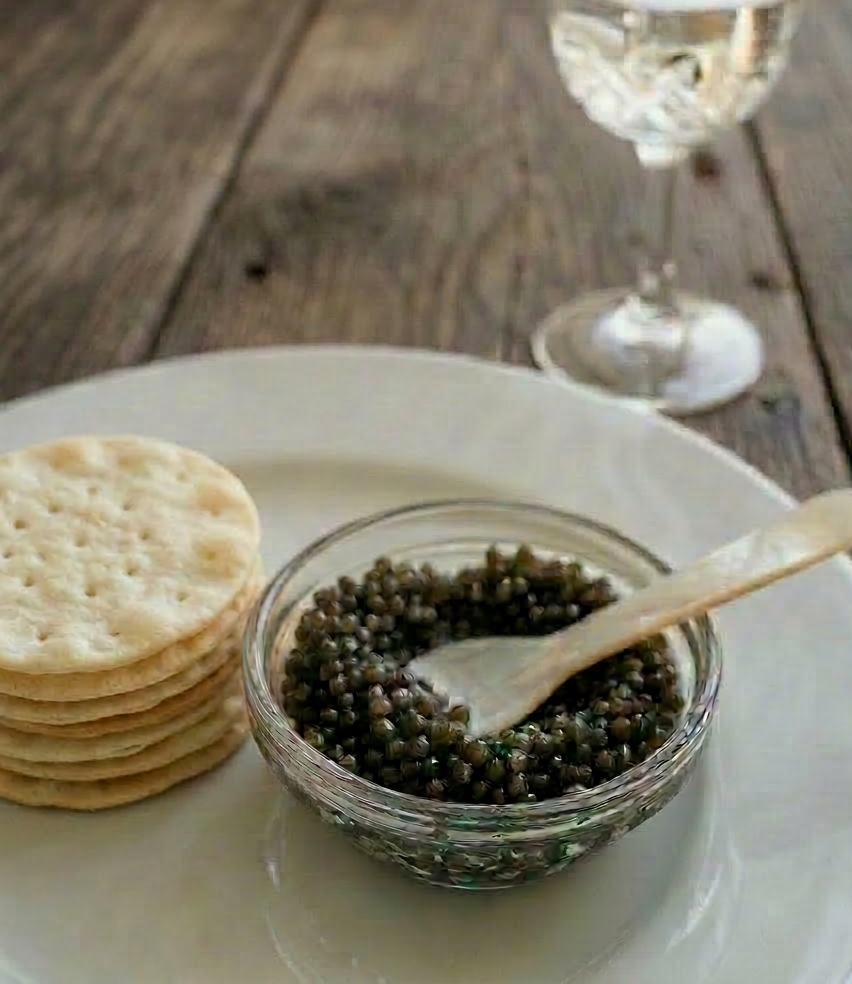
I still remember the first time I had caviar: its delicate structure bursting like bubbles as my tongue pressed the tiny eggs to the roof of my mouth. The explosive flavor—salty, but not overly so … buttery … fishy, but again, not overly so. I was hooked, literally, from the first taste. But it wouldn’t be until years later that I learned the differences between real caviar, and the “other” stuff.
All caviar is roe, aka fish eggs. But not all fish eggs are caviar.
What is caviar?
Think about it like this, there’s Champagne, and then there’s sparkling wine—both good, but not the same. By law, in order to be labeled “caviar” it must be sturgeon roe. So salmon roe is not caviar. Trout roe is not caviar. And so on. The most prized caviar in the world comes from beluga sturgeon in the Caspian Sea. Unlike Champagne, however, it’s not the region where the roe is harvested that makes it caviar, it’s the fish itself. So, roe from a Louisiana-raised sturgeon is caviar just as roe from a French sturgeon is caviar.
Three “common” types of caviar
Beluga: Harvested from beluga sturgeon primarily in the Caspian Sea but also found in the Black Sea and the Adriatic. Imports of this black, pea-sized caviar was banned by the U.S. Fish & Wildlife Service in 2005 due to the massive decline in population of beluga sturgeon. However, in January 2016, the U.S. lifted its trade embargo on Iranian goods and a small, 18-pound shipment of the delicacy was brought in and distributed in select cities. Even so, legal harvesting of wild sturgeon from both the Caspian and the Black Seas is banned and therefore, any and all caviar from this region should be avoided. One other interesting thing to note, in the early 2000s, before trade restrictions were enacted, Florida-based Sturgeon Aquafarms legally imported live sturgeon broodstock (including beluga). Then, in July 2016, they obtained a permit exemption to trade beluga sturgeon in the U.S. and is now the only group in the country offering this delacy.
Harvested from the very rare Siberian Albino Sturgeon, Strottarga Bianco is mixed with 22-karat gold flakes and can cost upwards of $27,000 per teaspoon. (No, that is not a typo.)
Osetra: From the osetra sturgeon, this roe is smaller than beluga and has a distinctively nutty taste. It varies in color from the more commonly seen dark brown to a rare golden yellow, known as royal caviar. Many chefs actually prefer its texture and taste over beluga making it a popular and more affordable—although still expensive—menu item. And, it’s being farmed successfully in many countries (including the U.S.) making it a sustainable choice for true caviar lovers.
Sevruga: This type of caviar is the third most expensive (behind beluga and osetra). Hailing from the sevruga sturgeon, it’s dark grey (almost back) in appearance and is a bit stronger than the other two making it perfect for “popping” with your tongue against the roof of your mouth.
Farmed: Yes, there is such a thing … and farmed caviar is the only type of caviar that gets a thumbs up from the Seafood Watch. AND, quite frankly, it is the only type of caviar you should consume. Here in the U.S., Marshallberg Farms uses recirculating tanks in their North Carolina operation to deliver consumers their sustainable, Osetra caviar. And in Northern California, two U.S. caviar farms, Sterling Caviar and Roe Caviar, are raising white sturgeon that produce brilliant, delicious and sustainable caviar.
Want to learn more? Check out what Gordon Ramsey has to say about farmed caviar …


Leave a Reply